
Description
“This journey changed my life. I really appreciate all that I learned from the course.”
Antonio D.F. · Make Some Waves
“The instructors were the real thing — people who actually live this music.”
Make Some Waves participant
Early bird — until 15 December 2026
1.300 € 1.500 €
12 masterclasses · 48 hours · max 10 students. From 16 December the price is 1.500 €.
New to this?
Talk to me before you book.
No experience is needed for this course — but if you’re unsure whether it’s for you, ask. I’ll walk you through the 12 weeks and tell you honestly whether this is the right starting point.
Book a free call — about 20 min
Message me on WhatsApp
Free · Vojto, Director of Berlin School of Sound · Replies Mon–Sat
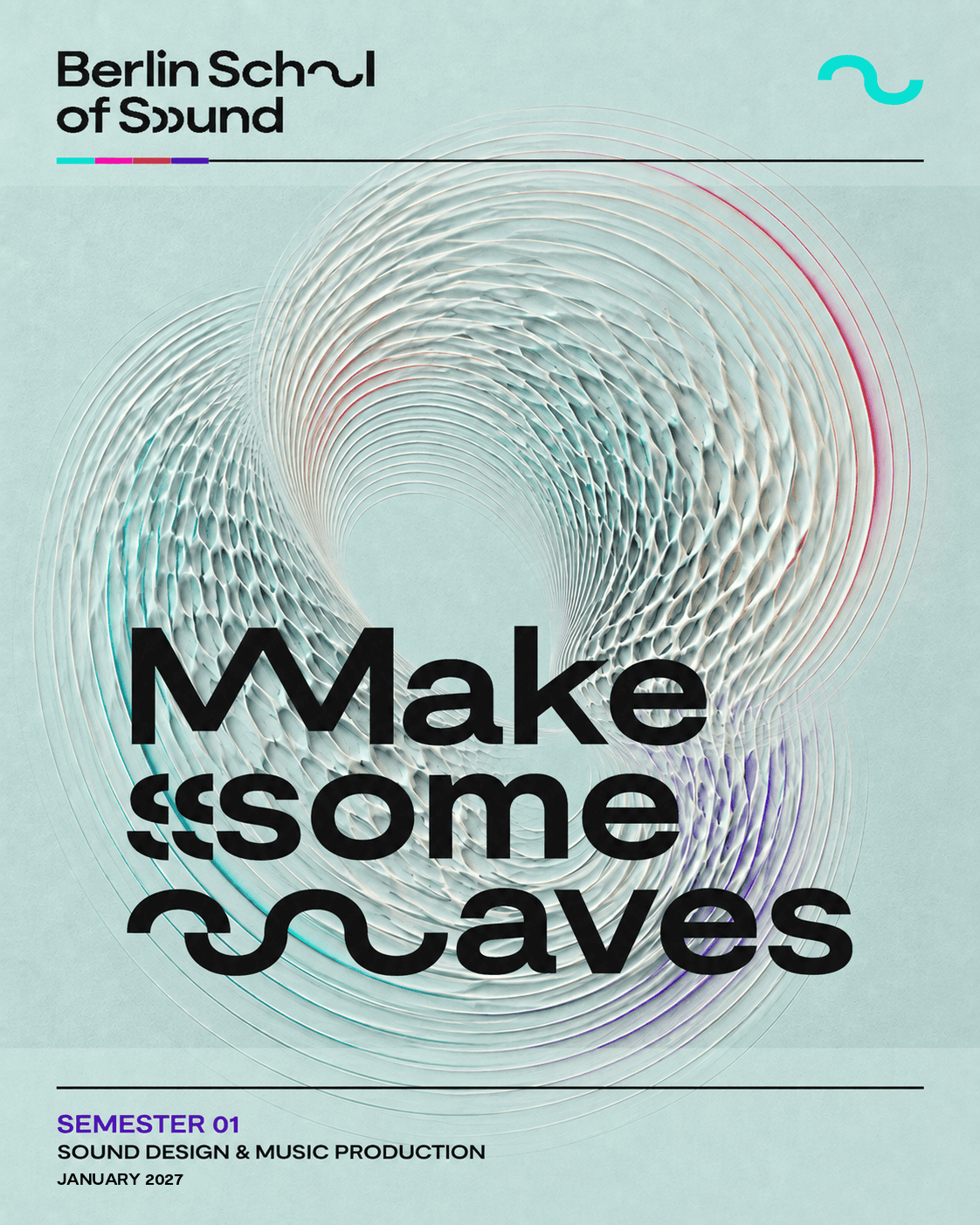
Beginner semester · January 2027
Start from zero.
Finish with music you made.
Make Some Waves 1 is a beginner electronic music production course in Berlin. No previous experience required — you start with an empty Ableton project and end the semester with finished work and a portfolio.
It is built as a series of 12 masterclasses, each taught by a working Berlin artist in their own field. You learn production the way it is actually practised: by making things, every week, with someone who does this for a living standing next to you.
Seven disciplines
What the 12 masterclasses cover
| 5 × | Ableton Live foundations |
| 2 × | Modular synthesis |
| 2 × | Field recording |
| 1 × | Sound installations |
| 1 × | Sound design for games |
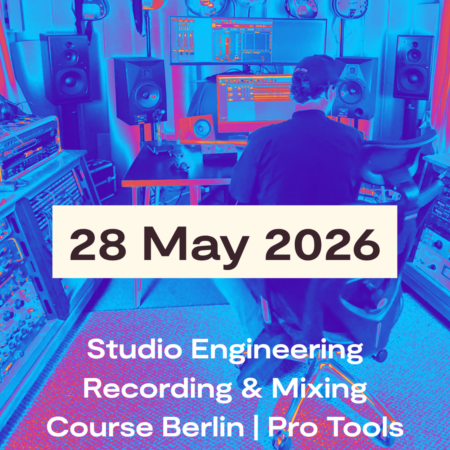
| 1 × | Mixing |
Dates
Mondays · 17:30–21:30
18.01 · 25.01 · 01.02 · 08.02 · 15.02 · 22.02 · 01.03 · 08.03 · 15.03 · 22.03 · 05.04 · 12.04.2027
No session on 29.03 — Easter Monday. 12 sessions × 4 hours = 48 hours.
By the end of the semester you will
→ Be able to build a track in Ableton Live from an empty project to a finished arrangement
→ Know how to record, edit and process your own sounds
→ Have patched and recorded a modular synthesizer
→ Have made field recordings in Berlin and turned them into music
→ Understand how sound works in games and installations
→ Know how to mix your own material
→ Have original work you can show people
Course structure
Ableton Live: First Steps
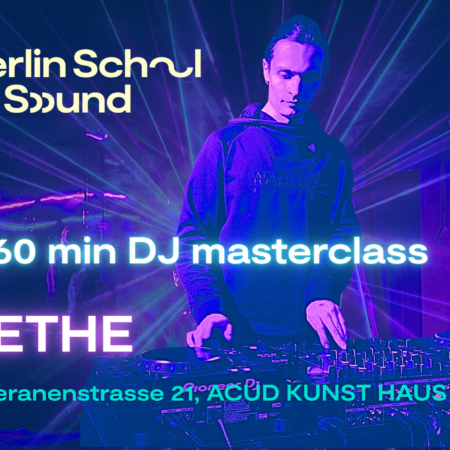
RETHE
The interface without the fear. Session vs Arrangement view. Importing and playing audio. Setting tempo and key. Your first eight bars by the end of the evening.
Ableton Live: Drums & Sampling
RETHE
Building beats with Drum Rack. Slicing and chopping samples. Groove and swing. Layering sounds so they sit together.
Ableton Live: Synthesis & Sound Design
RETHE
How a synthesizer actually works. Oscillators, filters, envelopes. Wavetable and Operator. Designing a bass, a pad and a lead from scratch.
Ableton Live: Arrangement
RETHE
Turning a loop into a track. Structure, tension and release. Automation. Transitions that don’t sound like a crossfade.
Ableton Live: Effects & Processing
RETHE
EQ, compression, reverb and delay — what each one is for. Creative processing. Effect racks and chains. Making a track sound finished.
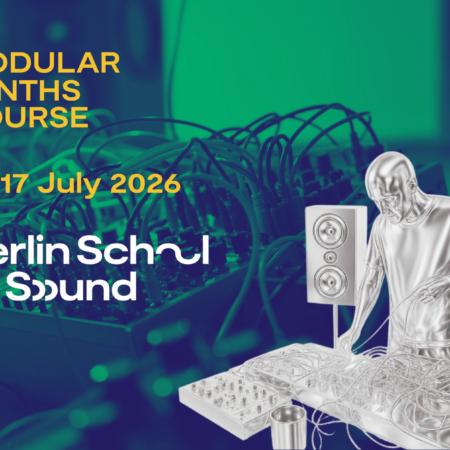
Modular Synthesis: Fundamentals
Stéphane Lefrançois
Patch cables, signal routing, oscillators, filters, envelope generators. Voltage as an idea. Your first ambient and drone compositions.
Modular Synthesis: Patching & Generative Systems
Stéphane Lefrançois
Cross-modulation, feedback loops, sequencers and randomisation. Evolving textures and self-playing systems. Recording a modular performance.
Field Recording: Capturing Berlin
Antje Vowinckel
Microphones, recorders and technique. Listening as a practice. Recording in the city — streets, stations, rooms, objects.
Field Recording: From Recording to Composition
Antje Vowinckel
Editing and processing recordings. Space and object resonance. Building a piece out of material you captured yourself.
Sound Installations
Georg Werner
Sound in space rather than in headphones. Spatial audio fundamentals. Site-specific thinking. Documenting work that only exists in a room.
Sound Design for Games
Dario Beckmann
Interactive and adaptive audio. FMOD, Wwise and Unreal Engine. Sound effects and environmental audio. How game sound differs from linear music.
Mixing
Henning Grambow
Balance, depth and width. Gain staging. Common beginner mistakes and how to hear them. Mixing your own semester track.
Final showcase at ACUD Kunsthaus — your work presented in front of an audience. Friends, family, Berlin’s music community.
Your instructors
RETHE — 5 masterclasses · Ableton Live
Berlin-based producer and live performer. Releases on ARTS, Illegal Alien and BCCO. Expert at track selection, storytelling through music, and hardware/software integration.
Stéphane Lefrançois — 2 masterclasses · Modular synthesis
Drummer, recording engineer, performing artist and teacher based in Berlin. Studios in London, Ibiza and Berlin. Founder of Secret Music label.
Antje Vowinckel — 2 masterclasses · Field recording
Composer and radio artist working with field recording, voice and text. Her work is broadcast and performed internationally.
Georg Werner — 1 masterclass · Sound installations
Artist working in audiovisual installation and spatial sound.
Dario Beckmann — 1 masterclass · Game audio
Game audio specialist working with FMOD, Wwise and Unreal Engine.
Henning Grambow — 1 masterclass · Mixing
Producer and mixing engineer, co-owner of Sugar Candy Mountain Studio in Berlin.
What’s included
| 48 hours of instruction across 12 masterclasses |
| 6 working Berlin artists as instructors |
| Maximum 10 participants |
| Access to modular systems, recording and field recording equipment, microphones, mixing desk, monitors, turntables and DJ gear |
| Group critiques and peer feedback sessions |
| Public final showcase at ACUD Kunsthaus |
| Certificate of completion |
What you need to bring
No music production experience required. You need basic computer literacy, your own laptop and headphones, a notebook, basic English for technical instructions, and willingness to experiment and collaborate.
Details
| Starts | Monday 18 January 2027 · 12 weeks |
| Time | Mondays 17:30–21:30 |
| Place | ACUD Kunsthaus, Veteranenstraße 21, 10119 Berlin-Mitte |
| Group | Max 10 participants |
| Price | 1.300 € early bird until 15.12.2026, then 1.500 € |
| Language | English |
Frequently asked questions
Do I need any experience to join?
No. This is the beginner course. If you have never opened a DAW, you are exactly who this semester is for.
How much does the course cost?
1.300 € if you book by 15 December 2026, and 1.500 € after that. The price covers all 12 masterclasses, 48 hours of instruction, studio access and the final showcase.
Do I need to own Ableton Live?
It helps, but you can start with the free trial and decide later. You do need your own laptop and headphones.
Where does the course take place?
At ACUD Kunsthaus, Veteranenstraße 21 in Berlin-Mitte.
What language is the course taught in?
English. You don’t need German to take part.
What is the difference between Semester 1 and Semester 2?
Semester 1 is the foundation — you learn the tools across seven disciplines. Semester 2 is where you compose, produce and build a live act with those tools.
How many people are in the group?
Maximum 10, so everyone gets individual attention every week.
Still have questions? Write to contact@berlinschoolofsound.com — we reply within 24 hours.
Reviews
There are no reviews yet.