
“How do we move from the mind to the body, and from the body to the machine?”

with Gugulethu Anathi Duma (Dumama)

Sounds from a Listening Body is a three-month intensive for vocalists, composers, and performers seeking to dismantle perfectionism and performance anxiety.

Rooted in Black ontological frameworks, trauma-informed somatic care, and deep listening, this course treats the voice as a resonant archive. We begin by unlearning the constraints of traditional training — moving from ancestral body noise and embodied ecologies into experimental sonic composition. By engaging the analog body before touching the digital interface, we explore the symbiotic relationship between the creator and their tools.

Whether you’re a classically trained musician looking for freedom, a “recovering” vocalist, or a sound artist curious about the intersection of movement and electronics, this process offers a space to cultivate resonance, unlock vocal potential, and build a cohesive body of original work.
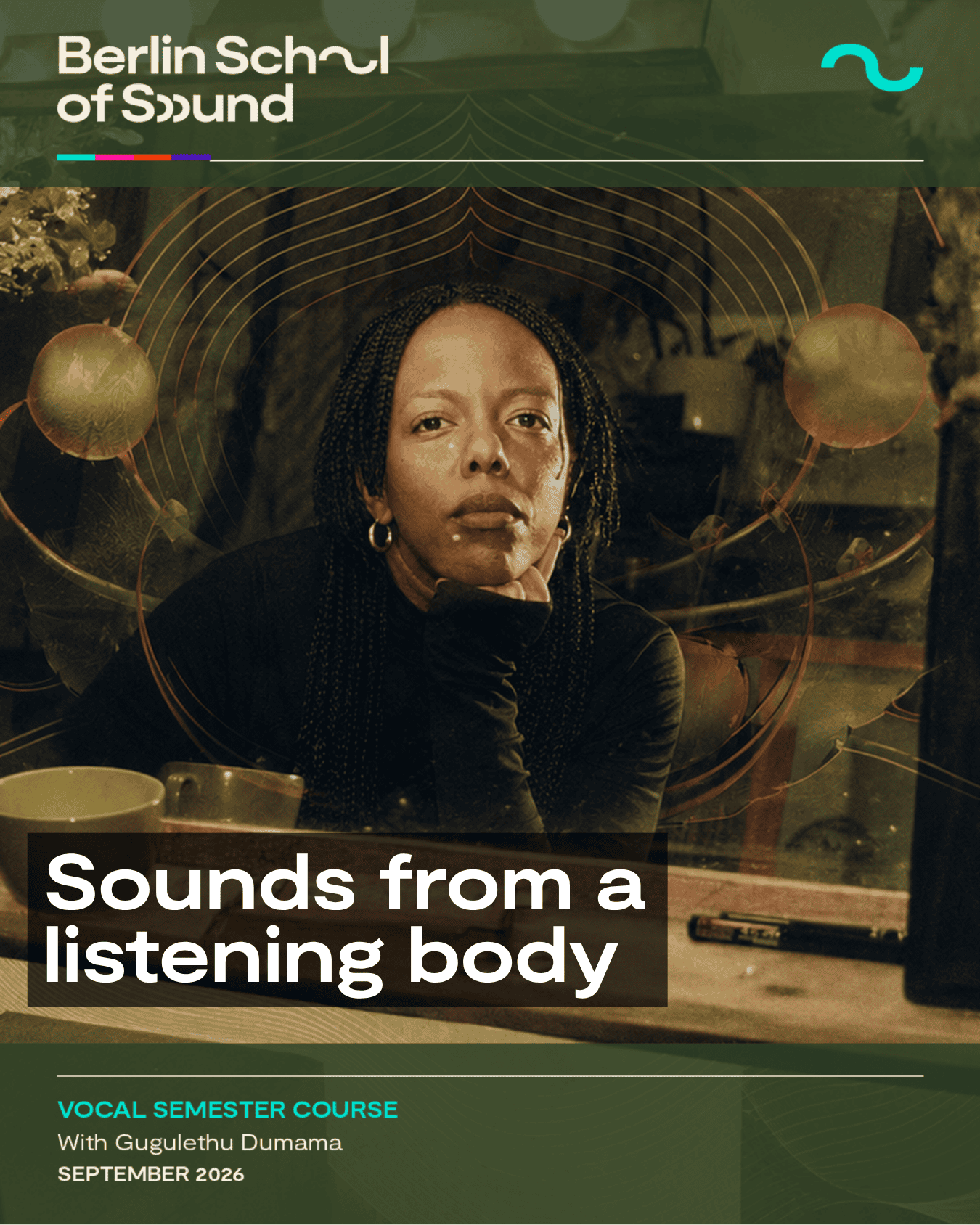
Gugulethu Anathi Duma (Dumama)
By the end of this course
  • You’ll have dismantled habitual performance anxiety and perfectionism in your voice.
  • You’ll use improvisation and movement as compositional tools.
  • You’ll have recorded and processed a body of original vocal material.
  • You’ll treat the DAW as an extension of the somatic voice, not just an editor.
  • You’ll perform in a final collaborative showcase of your own compositions.
The three-month arc

From analog ecology
to digital composition

I
The Resonant Archive
De-conditioning the voice and grounding in somatic consciousness.
001
Deep listening
Introductions to “deep listening” and dismantling perfectionism; identifying somatic holding patterns.
002
Ancestral body noise
Vocal warm-ups focused on breath, overtone textures, and physical release.
003
Mapping the sonic body
Exercises to move from habitual thinking to felt/sensorial experience.
004
Embodied ecologies
Vocalizing in relation to space, silence, and collective rhythm (collaborating with our natural world).
II
Improvisational Logic & Songwriting
Translating physical movement into musical language.
005
Improvisation as research
Unlocking the voice without attachment to outcome.
006
Choreography as score
Using movement and gesture as the primary compositional tool for songwriting.
007
Performance anxiety processing
Creating safe containers for visibility and witnessing.
008
The song as a body
Layering, text, and melody through improvisational experimentation.
III
Digital Synthesis & Final Composition
Bridging the analog and digital; finalizing a body of work.
009
Introduction to the DAW
Treating the software as an extension of the somatic voice rather than an editor.
010
Digital sculpture
Granulation, looping, and processing analog vocal material recorded in Month 2.
011
Future-facing composition
How our digital tools shape our sonic sensibilities and vice-versa.
012
Final sharing / performance
A collaborative showcase of the digital bodies of work developed during the course — culminating in a group choir performance, voices woven together as one resonant body.

Who this is for

This long-term format offers space to truly recover, re-member, and calibrate the voice — asking: what does it mean to be a voice, what does it mean to have a voice. No specific technical background required. What’s required is willingness: to sit in discomfort, to unlearn, to be witnessed.

What to bring

Bring your journals and recording material to every session — a Zoom recorder or phone recorder both work, though Zoom is preferred.

Details
Schedule 12 sessions, every Wednesday
Starts 16 September 2026
Time 17:30 – 21:30
Location ACUD Kunsthaus, Berlin-Mitte
16.09 23.09 30.09 07.10 14.10 21.10 28.10 04.11 11.11 18.11 25.11 02.12 — Performance
Flexible payment available — split your tuition 50:50 (deposit + balance) or ask about installments. Many students take this option.