
Description
Build Your Own DIY Synthesizer — with Corazón de Robota
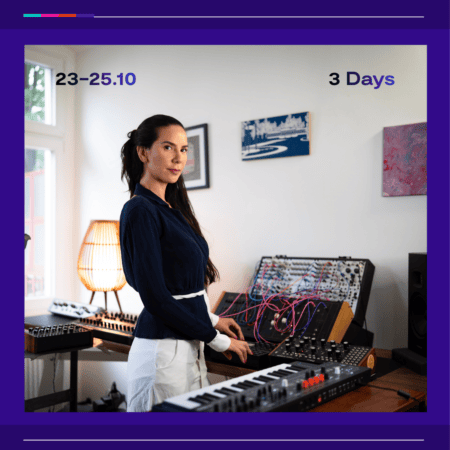
Corazón de Robota (Constanza Piña Pardo) is a Chilean sound artist, instrument builder and performer whose practice lives at the intersection of DIY electronics, circuit design and experimental sound. She builds her own instruments from scratch — and over three days, she’ll show you how to build yours.
This is not a workshop about using synthesizers. It’s a workshop about building one — soldering iron in hand, circuit by circuit, until the instrument you walk out with is entirely your own.
Day 1 — Circuits & Sound
Electronics Fundamentals & Oscillators
Understanding sound as an electrical signal — and how the simplest circuits generate it.
- Introduction to DIY electronics: components, tools and safe soldering practice
- Reading a circuit diagram (schematic)
- Basic oscillator circuits — how a simple loop becomes a tone
- Resistors, capacitors and transistors as sound-shaping tools
- Building and testing your first sound-generating circuit
- Circuit bending as a creative, experimental practice
Assembly, Modulation & Control
Turning circuits into a playable instrument — adding control, expression and character.
- Soldering the full synth board, step by step
- Adding potentiometers, switches and control interfaces
- Basic modulation — LFOs and simple envelope shaping
- Housing and physical design — making the instrument playable and personal
- Troubleshooting: reading your circuit when something doesn’t work
Finding Your Instrument’s Voice
Finishing your build and learning to perform with it — an instrument is only complete once it’s played.
- Final assembly and sound-testing your finished synth
- Exploring the instrument’s sonic range and idiosyncrasies
- Basic performance techniques for handmade electronic instruments
- Group listening session — hearing what everyone built
- Where to go next: expanding and modifying your instrument at home
Your results
- A fully built, working DIY synthesizer — yours to keep
- Practical soldering and circuit-building skills you can apply to future builds
- An understanding of how sound circuits actually work, not just how to use them
- Basic performance experience with your own handmade instrument
- Confidence to keep building, modifying and experimenting on your own
Complete beginners are welcome — no electronics or soldering experience required. If you’re curious about how sound and circuits connect, and you want to leave with something you built entirely with your own hands, this is for you.