
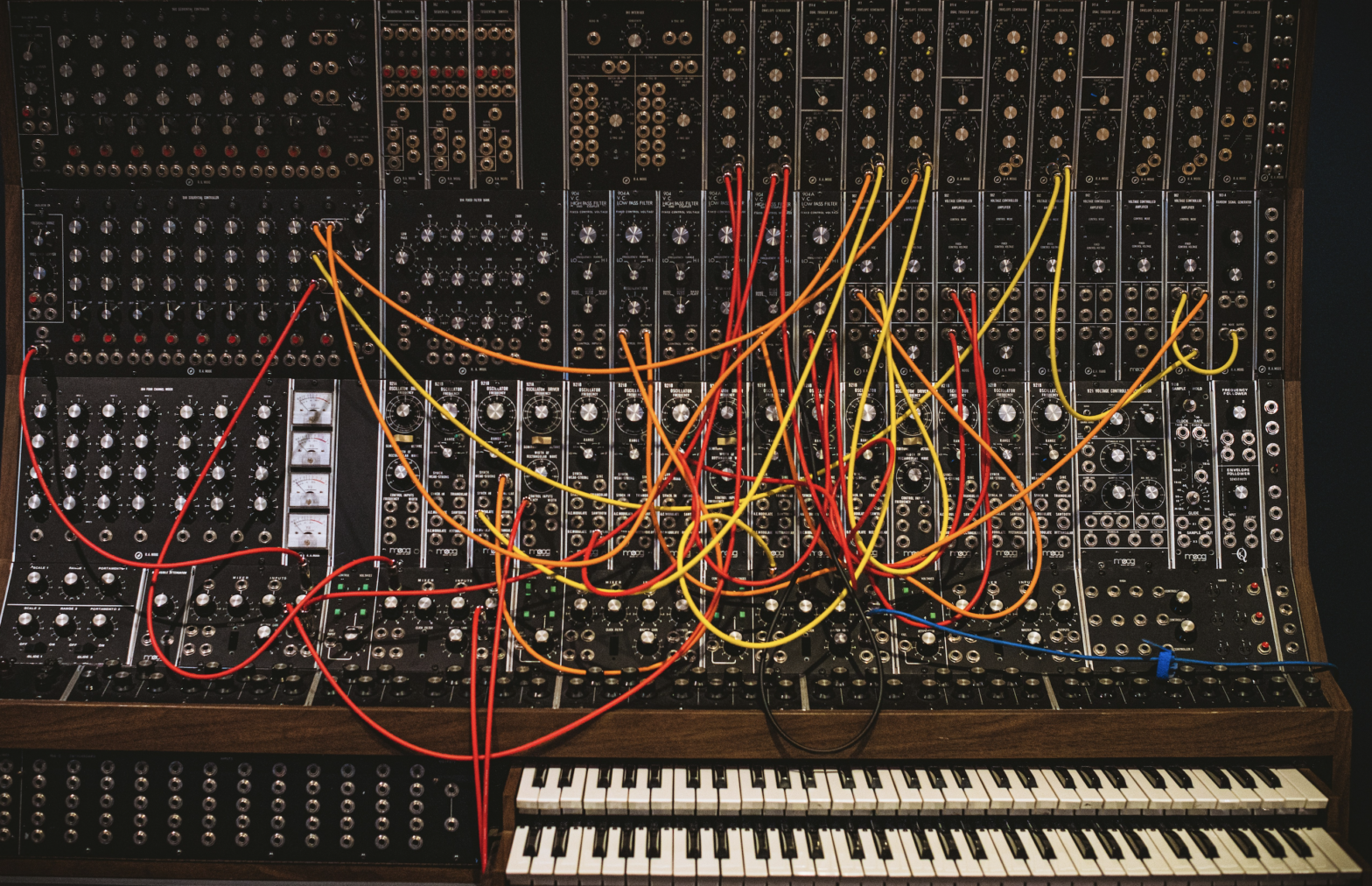
Every week at Berlin School of Sound, someone asks me the same question: “I want to get into modular synths — where do I even start?” And every week I give roughly the same answer, because the modular world hasn’t changed its core truth in decades: it’s incredibly easy to spend a lot of money very fast, and incredibly easy to end up with a pile of modules that don’t actually let you make music.
So here’s the guide I wish someone had given me. No hype, no “buy everything,” just a clear path from zero to your first real patch.
First: What Is Modular Synthesis, Actually?
A normal synthesizer has its oscillator, filter, envelope, and amplifier wired together internally by the manufacturer. You turn knobs, but the signal path is fixed.
A modular synth has none of that wiring done for you. Every function — oscillator, filter, envelope, LFO — lives in its own separate module. You connect them yourself with patch cables. The signal that comes out of one module can go into any other module’s input. The instrument you build is unique to your rack, your choices, your patch.
This is also why it’s called Eurorack — the standardised format (created by Dieter Doepfer in 1996) that lets modules from completely different manufacturers physically fit together and share power. Before Eurorack, modular synths from different brands simply couldn’t talk to each other. Eurorack is the reason the modular world exploded over the last 15 years.
Mistake #1: Buying Modules Before Understanding Signal Flow
This is the single most common — and most expensive — beginner mistake. People see a beautiful, weird-looking module on Instagram, buy it, get it home, and realise they have no oscillator to feed it.
Before you buy anything, understand the basic signal chain every patch needs:
Oscillator (VCO) → generates the raw sound
Filter (VCF) → shapes the tone, cuts or boosts frequencies
Envelope (ADSR/EG) → shapes how the sound starts and ends over time
Amplifier (VCA) → controls volume, usually driven by the envelope
LFO → a slow oscillator used to modulate other parameters, not to be heard directly
That’s a complete monophonic synth voice. Everything else — sequencers, effects, randomness generators, the truly weird modules — comes after you have that working.
The Real Question: Semi-Modular or Full Eurorack?
This is where I steer almost every beginner, and it’s the most useful decision you’ll make.
Semi-modular synths — like the Behringer CRAVE, MOOG Mavis, or Make Noise 0-Coast — work as complete, playable instruments straight out of the box, with no patch cables required. But every one of them also has patch points on the front panel, so the moment you want to break the internal signal path and do something unusual, you can. They are real modular instruments. They just come pre-wired with a sensible default.
This is the smart way in. You get a working synth immediately — you can make music with it on day one — and you learn patching gradually, one cable at a time, without needing a case, power supply, or five modules before you hear a single sound.
Stéphane Lefrançois, who teaches modular synthesis at Berlin School of Sound, gives his students a piece of advice worth repeating here: you don’t need to start with expensive boutique modules. Erica Synths’ Pico series is, in his experience, one of the best entry points into modular — compact, surprisingly capable modules at a price that lets you actually build a working voice without panic-buying a credit card limit’s worth of gear. And contrary to what gear snobbery on forums might suggest, both Doepfer and Behringer hold up well as beginner-friendly brands. Behringer in particular designs its own modules rather than just cloning others, and a number of them are genuinely well thought out and well priced. You don’t need to jump straight into the expensive boutique end of the market to get a real, usable modular voice.
Stéphane’s other piece of advice: don’t underestimate how many envelope and filter modules you actually need. Beginners often buy one of each and wonder why their patches sound thin or static. A handful of envelopes and at least one good filter give you the dynamic shaping that makes a patch feel alive rather than just “on.”
If you skip straight to a full Eurorack case and loose modules without this kind of guidance, expect to spend more, understand less in the first month, and very possibly end up with a case full of modules that don’t actually connect into a useful patch.
If You Do Go Eurorack: The HP Rule
Eventually, most people do move into a full Eurorack case. When you do, there’s one rule the entire modular community agrees on: buy a bigger case than you think you need.
Module width is measured in HP (Horizontal Pitch — 1HP = 5.08mm). A single complete voice — oscillator, filter, envelope, VCA, LFO — typically needs 40-50HP minimum. The instinct is to buy a small 84HP skiff to save money. The near-universal experience is that you fill it within weeks and immediately regret not buying bigger. Going for 168-208HP from the start usually costs less than buying two cases.
Also: get a powered case, not an empty frame. Sourcing and wiring your own Eurorack power supply involves mains voltage and is not where beginners should be improvising.
A Realistic Starting Path
Step 1 — Patch for free. Before spending a euro, download VCV Rack (free software) and patch virtually for a few weeks. It teaches you signal flow, patch cable logic, and the vocabulary, with zero financial risk.
Step 2 — Get your first modules without overspending. Look at Erica Synths’ Pico series, Doepfer, or Behringer’s own Eurorack line — all three give you real, usable modular building blocks at accessible prices. Build a basic voice: oscillator, filter, a couple of envelopes, a VCA. Live with it for a few months. Learn what you actually want more of — more oscillators? more modulation? rhythm?
Step 3 — Expand based on what you’re missing, not based on what looks cool on a forum. If you keep wanting more rhythmic complexity, add a sequencer module. If you keep wanting weirder textures, add a second oscillator or a wavefolder. Let your own patches tell you what to buy next.
Step 4 — When you outgrow your starting setup, move it into a proper Eurorack case (168HP+, powered) alongside the new modules. Nothing from Step 2 goes to waste.
The Best Resources Beyond This Article
The modular community is unusually generous with free knowledge. Two YouTube channels — DivKid and mylarmelodies — explain complex patching concepts in a way that actually makes sense to newcomers. Patch & Tweak by Kim Bjørn and Chris Meyer is the book most experienced patchers recommend. And ModularGrid lets you plan an entire rack — sizes, prices, power draw — before buying a single module.
But reading and watching only gets you so far. Modular synthesis is fundamentally a physical, hands-on skill — the kind of thing that clicks when someone next to you points at your patch and says “try this instead.”
What We Actually Use in the Studio
At Berlin School of Sound, our modular setup isn’t built around the most expensive or most “serious” gear — it’s built around what actually teaches people fast and sounds good doing it. Two pieces are worth mentioning specifically, because they show that “modular” doesn’t always mean a wall of individual knobs.
The first is Poly Effects’ Hector — which is, in a sense, a modular system inside a single Eurorack module. It runs over 100 virtual modules (oscillators, filters, sequencers, a granular synthesizer, even ports of well-known Mutable Instruments designs) on a touchscreen interface, with real CV and audio inputs and outputs connecting it to the rest of a rack. For students, it’s a remarkable way to experience an enormous range of modular building blocks without needing to physically own all of them — you patch virtually, but the signal is real, hardware audio and CV the whole time.
We pair Hector with a Korg Monotribe — not a modular synth in the strict sense, but a small analog synth with a built-in analog rhythm generator and CV/gate I/O, which means it talks directly to Eurorack gear. Running Hector and the Monotribe together gives students a sound source with rhythm and a flexible, software-deep processing brain, without the cost or clutter of a full physical rack.
We also work with modules from Bart Instruments, a boutique builder whose modules are worth knowing about once you’re past the absolute basics and looking for something more characterful to add to a growing system.
Modular is just one piece of a much bigger picture. If you’re comparing music production courses in Berlin, our semestral programs bring synthesis, sound design, mixing, and DJing together under one roof — taught by working artists including Stéphane, rather than split across separate one-off workshops.
Learn From Someone Who Actually Lives It
One of our modular instructors at Berlin School of Sound, Stéphane Lefrançois, is a good example of where modular synthesis can actually take you. He’s a drummer, recording engineer, DJ, and label owner (Secret Music) who has run studios in London, Ibiza, and Berlin — and modular has become as central to his practice as a drum kit.

At Superbooth, Stéphane performs a project called ImPulse together with Jessica Kert, a well-known figure in the Berlin modular scene from SchneidersLaden. The setup is striking in its simplicity: Stéphane plays live drums while Jessica improvises on a Buchla 200e modular system, the two reacting to each other in real time the way a jazz duo would. It’s a clear demonstration of something we keep coming back to in this article: modular synthesis isn’t a separate, isolated discipline. It’s an instrument that integrates with whatever else you already do — drumming, DJing, composing, video.
Stéphane also works with video synthesis (LZX Industries modules), which is a good reminder that the Eurorack format isn’t limited to audio — the same patching logic applies to controlling visuals in real time. If you want to see his work directly, his discography and projects are at stephanelefrancois.com.
Learn it hands-on, in Berlin
Want to actually patch a modular system, not just read about it?
Make Some Waves — Semester 2 is our next-level 12-week semestral course with Stéphane Lefrançois, Nadia Struiwigh and RETHE at ACUD Kunsthaus — modular synthesis, advanced Ableton, live performance.
→ Explore Make Some Waves — Sem. 2
Book a free call with Vojto →
Free · 15 min · Vojto Monteur, Director of Berlin School of Sound